 Written by

If you have ever wondered whether the feeding chart on the back of the kibble bag really fits your dog, you are asking the right question. “How many calories does my dog need?” has a real answer, and a calculator plus two minutes of math gets you a solid starting estimate.
This guide walks you through the formula veterinarians use, a table of approximate daily calories by weight, and how to turn that number into cups. You will also learn to check body condition, budget for treats, and fine-tune portions over a few weeks.
How Many Calories Does My Dog Need? The Short Answer
Two dogs of the same weight can need noticeably different amounts of food. Age, neuter status, activity, and health all shift the number. The Merck Veterinary Manual describes calculated energy needs as only a starting point that may need to be modified based on how each dog responds. Treat every number here as a first draft, and let your dog’s weight and body condition over the next few weeks tell you whether it needs editing.
Slow Feeding for Weight Control & Portion Management
Get our expert cheat sheet delivered to your inbox — plus an exclusive 15% discount code for your first order.
Step 1: Calculate the Resting Energy Requirement
The resting energy requirement (RER) is the energy your dog burns at rest. Both the Merck Veterinary Manual and the American Animal Hospital Association (AAHA) use this formula:
RER (kcal per day) = 70 × (body weight in kg)0.75
On a phone calculator:
- Convert pounds to kilograms by dividing by 2.2.
- Cube it (kg × kg × kg).
- Press the square root button twice.
- Multiply the result by 70.
For a 22 lb dog: 22 ÷ 2.2 = 10 kg; 10 × 10 × 10 = 1,000; two square roots give about 5.62; and 5.62 × 70 is roughly 394 kcal per day. That is RER, not the final number.
Step 2: Apply a Life Stage Multiplier
Next, multiply RER by a life stage factor to get the maintenance energy requirement (MER), your estimated daily calorie target. The Merck Veterinary Manual lists these starting multipliers for healthy dogs:
- Neutered or spayed adult: 1.6 × RER
- Intact adult: 1.8 × RER
- Obesity-prone or less active adult: 1.4 × RER
- Puppy under 4 months: 3 × RER
- Puppy over 4 months: 2 × RER
Special cases:
- Weight loss: AAHA’s weight management guidelines note that feeding 80% of the RER calculated at your dog’s ideal weight (not current weight) is effective and well tolerated. Set this up with your vet.
- Seniors: There is no single official senior multiplier. Some older dogs gain easily while others lose muscle, so body condition matters more than age. See our guide to feeding enrichment for senior dogs.
- Active dogs: A dog that runs or hikes daily usually needs more than a couch companion of the same weight. Start at the standard multiplier and increase only if body condition slips.
- Puppies: Recalculate as they grow. Our puppy feeding schedule by age covers meal timing.
Approximate Daily Calories by Weight
These are estimates for healthy adult dogs at a good body condition, rounded to the nearest 10 kcal per day.
| Weight | RER | Less active (1.4×) | Neutered adult (1.6×) | Intact adult (1.8×) |
|---|---|---|---|---|
| 10 lb (4.5 kg) | 220 | 310 | 350 | 390 |
| 20 lb (9.1 kg) | 370 | 510 | 590 | 660 |
| 30 lb (13.6 kg) | 500 | 690 | 790 | 890 |
| 40 lb (18.1 kg) | 620 | 860 | 990 | 1,110 |
| 50 lb (22.7 kg) | 730 | 1,020 | 1,160 | 1,310 |
| 60 lb (27.2 kg) | 830 | 1,170 | 1,340 | 1,500 |
| 70 lb (31.8 kg) | 940 | 1,310 | 1,500 | 1,690 |
| 80 lb (36.3 kg) | 1,040 | 1,450 | 1,660 | 1,860 |
| 100 lb (45.4 kg) | 1,220 | 1,710 | 1,960 | 2,200 |
If your dog is overweight, feeding for current weight maintains the extra pounds. Ask your vet for an ideal weight and plan from there.
A Worked Example: A 50-Pound Neutered Dog
Say your 50 lb neutered adult is at a healthy body condition and eats kibble with 350 kcal per cup.
- Convert to kg: 50 ÷ 2.2 = 22.7 kg.
- Find RER: 22.70.75 is about 10.4, and 10.4 × 70 is about 730 kcal.
- Apply the multiplier: 730 × 1.6 is about 1,170 kcal per day. (The table shows 1,160 because it uses the unrounded RER of 727.)
- Set aside treats: 10% of 1,160 is about 115 kcal, leaving roughly 1,045 kcal for meals.
- Convert to cups: 1,045 ÷ 350 is about 3 cups per day, split across two meals.
Compare a 3-month-old puppy weighing 4 kg (about 8.8 lb): RER is about 198 kcal, and 3 × 198 is roughly 590 kcal per day, far more per pound than an adult needs.
How to Read Calories on the Food Label
Tufts University’s Petfoodology team explains that pet food labels now carry a calorie statement listed two ways: kcal per kilogram and kcal per cup or can.
- kcal/kg is useful if you weigh food. Divide by 1,000 to get kcal per gram.
- kcal/cup is the practical figure if you scoop.
- kcal per can applies to wet food.
One kcal equals one “Calorie” on a human food label. Tufts also notes that foods around 300 kcal per cup or less can give weight-conscious dogs more volume in the bowl.

Converting Calories to Cups
The math is simple: daily meal calories ÷ kcal per cup = cups per day.
Foods differ a lot. If your dog needs 590 kcal per day from meals, that is about 1.7 cups of a 350 kcal food but about 1.5 cups of a 400 kcal food. Switching foods without recalculating is an easy way to overfeed.
Use a real measuring cup, not a mug. Better yet, use a kitchen scale: AAHA recommends weighing dry food when possible because cups can be imprecise, especially for small dogs. For more on measuring, see our portion control guide for dogs and our daily amount by weight guide.
Check Your Dog’s Body Condition Score
Body condition tells you whether your dog’s weight is right. The World Small Animal Veterinary Association (WSAVA) uses a 9-point body condition score (BCS):
- 1 to 3 (too thin): Ribs, spine, or hip bones are easy to see or feel with little to no fat.
- 4 to 5 (ideal): Ribs are easy to feel under a thin fat covering, the waist is visible from above, and the belly tucks up when viewed from the side.
- 6 to 9 (too heavy): Ribs become hard or impossible to feel, the waist fades or disappears, and fat builds over the back, base of the tail, and eventually the neck and limbs.
Run your flat hands along your dog’s sides, then look from above and from the side. AAHA notes that each point above 5 equals roughly 10% excess body weight, so a dog scoring 7 is around 20% over ideal.
Leave Room for Treats: The 10% Rule
AAHA and VCA Animal Hospitals both suggest keeping treats to about 10% of daily calories, with the other 90% coming from complete and balanced food.
Subtract the treat allowance before calculating cups: a dog needing 800 kcal per day gets about 80 kcal of treats and 720 kcal of food. Training treats, chews, scraps, and lick mat toppings all count. Using kibble from the daily portion as rewards adds nothing extra.
Adjust Over 2 to 4 Weeks
Feed the estimated amount consistently, then watch what happens:
- Weigh your dog at the start, on the same scale each time.
- Reweigh every two weeks and recheck body condition.
- After 2 to 4 weeks, review the trend. If weight is creeping up, trim about 10%. If your dog is losing weight it does not need to lose, add about 10%.
- Repeat until weight holds steady at a BCS of 4 to 5.
For dogs on a vet-supervised weight loss plan, AAHA’s guidelines set a target of 1% to 2% of body weight lost per week and suggest cutting calories by 10% to 20% if loss is slower than that. VCA Animal Hospitals recommends weighing within the first week of a new plan and at least every other week after that.
Slow Down Meals to Help Your Dog Feel Fuller
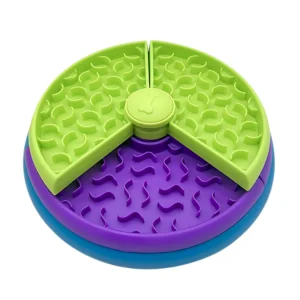
Getting calories right is half the job; the other half is helping your dog feel satisfied. VCA Animal Hospitals suggests a treat ball, puzzle feeder, or other interactive feeder to slow down eating and help dogs feel fuller.
A slow feeder turns a quick gulp into a longer meal without adding calories. Read more in can a slow feeder help my dog lose weight? If you have a big dog, our roundup of the best slow feeders for large dogs can help.
When to Call Your Vet
Talk to your veterinarian before changing calories if:
- Your dog scores 7 or higher, or you are planning weight loss.
- Weight changes up or down without a change in food or activity.
- Your dog seems hungry all the time, drinks noticeably more, or has less energy. VCA Animal Hospitals notes that hypothyroidism and Cushing’s disease are linked to weight gain.
- Your dog is a growing puppy, especially a large breed.
- Your dog is a senior or has a medical condition such as kidney, heart, or joint disease.
- Weight will not budge after several weeks of adjustments.
Turn the Numbers Into Calmer, Healthier Meals
Working out how many calories your dog needs comes down to three steps: calculate RER, apply the right multiplier, and convert to cups using the label. After that, body condition is your guide. Adjust in small steps, and involve your vet whenever health or weight loss is in play.
Once the portion is right, make it last. A maze-style slow feeder bowl or one of the options in our slow feeder bowl collection can turn a measured meal into a longer, more satisfying one.

Get Your Free Slow Feeding Cheat Sheet
Everything in this article — plus portion charts, feeder comparisons and meal plans — in one printable PDF. A 15% discount code is included.
Frequently Asked Questions
How many calories does my dog need per pound?
There is no fixed per-pound number, because needs do not rise in a straight line with weight. Small dogs need more calories per pound than large dogs, which is why the formula uses weight to the 0.75 power.
Is the feeding chart on the dog food bag accurate?
It is a reasonable starting point, but it covers a broad range of dogs. Compare it with your calculation and let body condition decide.
Should I use my dog’s current weight or ideal weight?
For a dog at a healthy body condition, use current weight. For an overweight dog, calculations are based on ideal weight, which your vet can help you estimate.
Do senior dogs need fewer calories?
Not necessarily. Many older dogs move less, while some lose muscle and weight. Check body condition every few weeks and adjust, rather than cutting food based on age alone.
Sources
The veterinary and animal-welfare resources referenced in this guide:
- Merck Veterinary Manual: Daily Maintenance Energy Requirements for Dogs and Cats
- AAHA: Weight Management Guidelines for Dogs and Cats
- WSAVA: Body Condition Score Chart for Dogs
- Tufts Petfoodology: What Are These Numbers? Nutrition Math 101
- VCA Animal Hospitals: Creating a Weight Reduction Plan for Dogs

Digital marketing specialist at BrightSeen Marketing Agency. Turns veterinary research into clear, practical feeding guides for pet parents.
Mahmoud works for BrightSeen Marketing Agency, which looks after our SEO and GEO and Meta ads.
View all articles by Mahmoud