 Written by
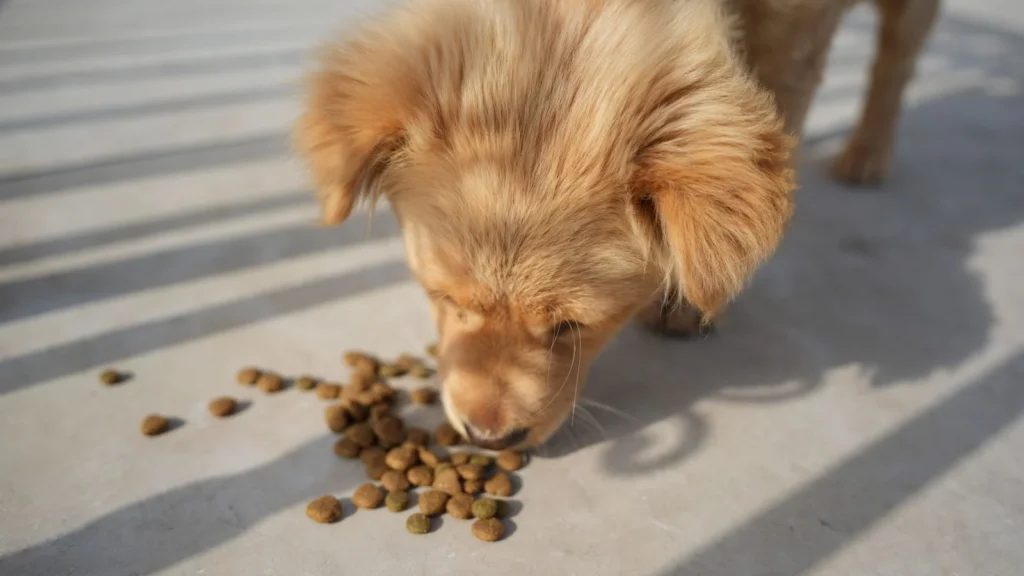
If you keep asking “why does my puppy eat so fast?”, the most common answers are simple: puppies learn to race for food in the litter, they are growing quickly and feel hungry, and long gaps between meals make them frantic when the bowl finally lands. Less often, worms or another health problem can drive a puppy to wolf food down, which is why a vet check is part of the plan.
The good news is that fast eating in a young dog is usually a habit, and habits can change. This post walks through each cause one at a time, explains which ones need a vet and which ones you can fix at home, and shows how to match the fix to the reason your puppy gulps. If you are looking for a step by step training schedule instead, our four week plan for a fast eating puppy covers that in detail.
Why Does My Puppy Eat So Fast? The Short Answer
Most puppies eat fast because eating fast has worked for them so far. In the litter, the puppy who got to the food first got the most. At home, a growing body makes them hungry, and an exciting new world makes everything feel urgent, including dinner.
Slow Feeding for Puppies & Kittens: Starting Right
Get our expert cheat sheet delivered to your inbox — plus an exclusive 15% discount code for your first order.
There are really two groups of causes, and it helps to sort your puppy into one of them before you buy anything:
- Learned and situational causes. Competition with littermates, other pets in the room, long gaps between meals, a bowl that makes gulping easy, and plain excitement. These respond well to changes in routine and equipment.
- Health causes. Intestinal worms, a diet that does not suit your puppy, or another medical problem that leaves them hungrier than they should be. These need your vet, not a new bowl.
If your puppy gulps its food and then vomits, call your vet before you work on the eating habit itself. Repeated vomiting, retching that brings nothing up, or a swollen belly means calling your vet right away. Rule out health problems first, then change the routine.
Litter Life: Competing for the Food Pan
For many puppies, fast eating starts before they ever come home. The ASPCA explains that young puppies often have to compete with their littermates for limited amounts of food, and that breeders often feed a whole litter from one large shared pan. The puppy who eats the most grows the quickest, so speed gets rewarded meal after meal.
Think about what that teaches a puppy at six or seven weeks old. Food appears, several siblings crowd in, and anyone who pauses to chew loses out. By the time your puppy arrives at your home, gulping may be a deeply practiced habit, even though nobody is competing with them anymore.
Signs your puppy learned speed in the litter
- They eat with their head down and do not look up until the bowl is empty.
- They push the bowl around the floor chasing the last pieces.
- They stiffen, eat faster, or freeze when someone walks past during a meal.
- They check other bowls or the floor right after finishing.
The last two signs overlap with early food guarding. The ASPCA notes that guarding food is a normal behavior for dogs, but it can range from growling to biting when a dog feels its food is under threat. That is one more reason to let a young puppy eat in peace and never reach into the bowl to “test” them.
What helps
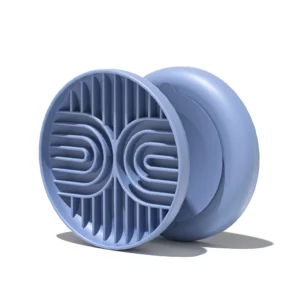
Give your puppy a calm, private place to eat where nobody walks through, and feed at the same times each day so meals feel predictable rather than scarce. A puzzle style bowl breaks up the food so speed simply stops working. A shallow, simple design like our Treat Maze Bowl is a gentle first step for small and medium puppies, because the ridges slow each bite without hiding the food completely.
A Growing Body With a Big Appetite
Puppies have a lot of growing to do, and that comes with a real appetite. A hungry puppy who meets a full bowl is going to dive in. That kind of enthusiasm is healthy in itself. The problem is only how quickly the food goes down.
It is tempting to read gulping as a sign your puppy needs more food. That is not always true. The AKC suggests that you monitor body condition, growth, and energy levels rather than focusing only on whether your puppy finishes every meal, and ask your vet to help decide if the amount needs to change. Many fast eaters are getting plenty of food and simply eat it quickly.
Check the basics before changing the amount
- Use the feeding guide on your puppy food as a starting point, then adjust with your vet.
- Measure every meal with a proper measuring cup or a kitchen scale instead of guessing.
- Count treats and training rewards as part of the day’s food.
- Weigh your puppy regularly or ask the clinic to weigh them at each visit.
Our puppy feeding chart explains how amounts change with age and weight, so you can see whether your puppy’s portions are in a sensible range before assuming hunger is the cause.
Long Gaps Between Meals
A puppy who waits a long time between meals arrives at the bowl very hungry, and very hungry puppies eat fast. Small stomachs do best with smaller meals spread through the day.
The AKC says that most puppies eat four meals daily between 6 and 12 weeks, three meals daily between 3 and 6 months, and two meals daily after 6 months of age. If a young puppy is getting only one or two large meals, every one of those meals turns into a race.
The AKC also notes that feeding smaller amounts two to three times a day rather than one large evening meal has been shown to reduce the risk of bloat in dogs. For a puppy, splitting the day’s food into the right number of meals is often the single easiest change you can make.
Simple ways to close the gap
- Set meal times on your phone so meals do not slide later on busy days.
- Use part of a meal as training rewards in the afternoon, so food arrives in small amounts.
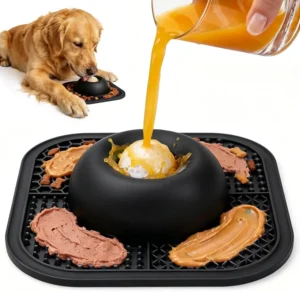
- Offer a small portion on a lick mat during quiet time instead of handing out extra treats.
Our puppy feeding schedule by age includes a sample timetable if you need help fitting meals around work and school.
Other Pets Nearby at Mealtime
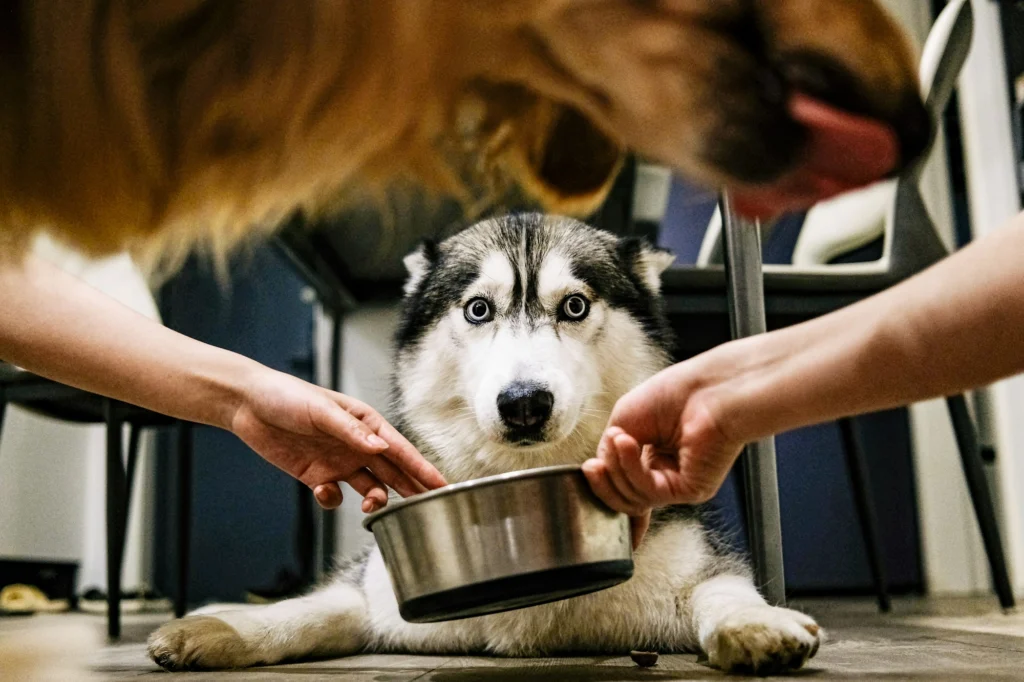
Even a calm puppy can start gulping if an older dog or a cat hangs around the feeding area. To your puppy, another animal near the bowl looks a lot like a littermate waiting to steal dinner.
The American Kennel Club notes that a fast eater who lives with other dogs may do better being fed separately, since separating dogs at feeding times may help reduce anxiety and stress around food. That works just as well for puppies, and it also keeps an adult dog from finishing the puppy’s food, or the other way around.
Set up separate feeding stations
- Feed the puppy in a crate, a pen, or behind a baby gate.
- Put the bowls down at the same time and pick them up once everyone has finished.
- Do not leave food out between meals where pets can graze or squabble.
- Keep the cat’s food up high or in a room the puppy cannot reach.
For more ideas on homes with several animals, see our post on feeding multiple dogs in one household.
Worms and Other Health Reasons to Rule Out
Sometimes a puppy eats fast because something inside is making them hungry. Intestinal worms are a common example in young puppies.
Cornell University’s Riney Canine Health Center explains that puppies can be infected with roundworms from their mother, both before birth and while nursing. Signs can include diarrhea, vomiting, a pot-bellied look, poor coat quality, weight loss, and stunted growth. Cornell also notes that puppies should receive dewormer routinely, starting at two weeks of age and repeating every two weeks until about eight weeks old, then continuing monthly.
Not every puppy with worms shows signs, so ask your vet whether your puppy is up to date on deworming and whether a stool test makes sense. Bring a fresh stool sample to the first visit if the clinic asks for one.
When to call your vet
- Your puppy seems hungry all the time and is not gaining weight.
- You see worms in stool or vomit, or the belly looks swollen.
- Your puppy has diarrhea, vomits, or seems tired or weak.
- Your puppy coughs, gags, or chokes during meals.
If your puppy vomits after eating, call your vet rather than waiting to see if it settles. Our post on why a dog throws up after eating explains the common reasons, but it is not a substitute for an exam.
Is Fast Eating Dangerous for Puppies?
Eating fast is not an emergency in itself, but it does carry risks worth taking seriously. The AKC lists choking, vomiting, discomfort, and a higher risk of bloat as problems linked to eating too quickly, and explains that dogs who gulp also swallow a lot of air with their food.
Bloat, or gastric dilatation-volvulus (GDV), happens when the stomach fills and can twist. The AKC describes it as immediately life threatening. It is more often discussed in adult large and deep-chested dogs, but if any puppy has a swollen belly, retches without bringing anything up, drools heavily, or seems restless and in pain after a meal, treat it as an emergency and get to a vet right away. Our guide to dog bloat symptoms lists the warning signs.
For most puppies, the realistic everyday problems are smaller: gagging on kibble, bringing food back up, gas, and a dog who learns that meals are a race. Fixing the habit early means you are not trying to change it in a much bigger, stronger adult dog later.
Do Puppies Need Slow Feeders?
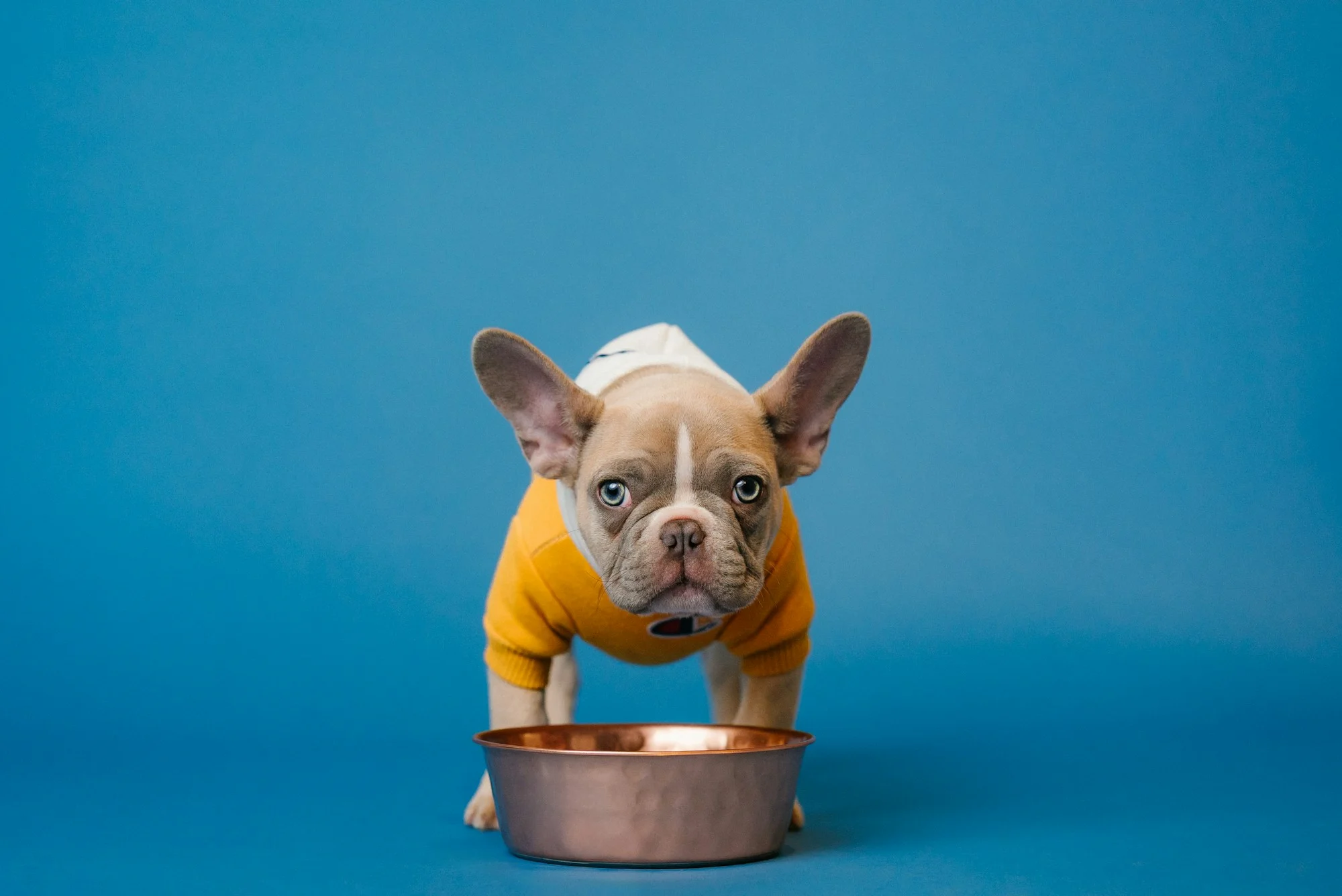
Not every puppy needs one. If your puppy eats calmly, chews, and never gags, a normal bowl is fine. But if your puppy finishes in seconds, coughs during meals, or brings food back up, a slow feeder is one of the simplest tools you can add.
The AKC recommends slow feeder bowls and food puzzles as ways to help dogs eat at a slower pace, along with low cost options such as spreading kibble on a cookie sheet, using a muffin pan, or hand feeding during training. All of these work for puppies, too.
Choosing a first slow feeder for a puppy
- Keep it easy. A puppy who cannot reach the food will get frustrated and may give up or chew the bowl. Start with shallow ridges.
- Match the size. Pick a bowl that fits your puppy’s muzzle now and still works at their adult size. Our bowls are made for small and medium dogs and cats.
- Pick sturdy, washable materials. Puppies chew. Watch the first few meals and remove any feeder your puppy starts to bite apart.
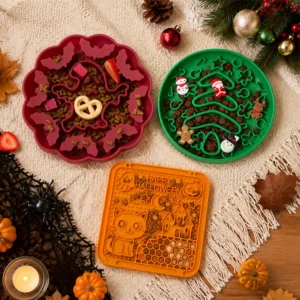
- Add variety later. Once your puppy handles a simple bowl, a lick mat like our Slow Licking Mat is great for soaked kibble or wet food.
Our post on when to start a puppy on a slow feeder covers age and introduction in more depth, and our guide to the best slow feeder bowl for puppies compares designs. You can browse all slow feeder bowls in our shop.
Matching the Fix to the Cause
The fastest way to slow your puppy down is to fix the actual reason they gulp. Here is a simple way to match causes and fixes:
| Likely cause | What you might notice | First thing to try |
|---|---|---|
| Litter competition habit | Head down, bowl pushed around, stiff when people pass | Quiet private spot, puzzle bowl, no hands in the bowl |
| Long gaps between meals | Frantic at mealtime, calmer when fed more often | Split food into the right number of meals for age |
| Other pets nearby | Eats faster when another animal is in the room | Separate feeding stations behind a gate or in a crate |
| Easy, wide open bowl | Eats calmly but finishes in a few gulps | Slow feeder bowl, cookie sheet, or muffin pan |
| Worms or another health issue | Always hungry, pot belly, diarrhea, poor growth | Call your vet and ask about deworming and a stool test |
| Excitement and boredom | Bounces around the bowl, eats, then looks for more action | Use some food for training games and puzzles |
Many puppies have more than one cause at the same time. A puppy from a big litter who now lives with an older dog may need both a private feeding spot and a puzzle bowl. Change one thing at a time for a few days so you can see what is working.
If you need a full set of slowing techniques for an older pup, our guide on how to stop a dog from eating too fast goes through each option, and our post on the signs your dog eats too fast helps you judge whether the changes are working.
Slower Meals, Calmer Puppy
A puppy who eats fast is usually showing you what life in the litter taught them, how hungry a growing body feels, or how exciting and uncertain mealtime still is. Rule out worms and other health problems with your vet, give your puppy the right number of meals for their age, feed them somewhere calm, and let a slow feeder or puzzle do the rest.
Most puppies settle within a few weeks once meals feel predictable and safe. If your puppy vomits, chokes, or seems unwell after eating, call your vet straight away. For extra ways to make mealtime a calm game, the Pawzzle Feeder Ball turns part of a meal into play once your puppy has mastered a simple bowl.
Get Your Free Slow Feeding Cheat Sheet
Everything in this article — plus portion charts, feeder comparisons and meal plans — in one printable PDF. A 15% discount code is included.
Frequently Asked Questions
Is it normal for a puppy to eat fast?
Yes, it is very common. Many puppies learned to eat quickly while competing with littermates, and growing puppies are hungry. It becomes a concern when your puppy chokes, gags, vomits, or seems hungry all the time without gaining weight. In those cases, talk to your vet before changing anything else.
Should puppies use slow feeders?
Puppies that gulp, gag, or bring food back up can benefit from a slow feeder. Start with a shallow, easy design so your puppy does not get frustrated, and watch the first few meals to make sure they are not chewing the bowl. Calm, steady eaters can keep using a normal bowl.
Can a puppy choke from eating too fast?
Yes. The AKC lists choking as one of the risks of eating too quickly. If your puppy coughs, gags, or struggles to breathe during a meal, stop the meal and call your vet. Slowing meals down with a puzzle bowl, a cookie sheet, or smaller portions can lower the risk.
Will my puppy grow out of eating fast?
Some puppies calm down as meals become predictable, but many keep the habit into adulthood unless something changes. Feeding at regular times, giving your puppy a quiet place to eat, and using a slow feeder early make it much easier to build a slower habit for life.
What should I do if my puppy throws up after eating fast?
Call your vet. Vomiting in a young puppy can have many causes, including worms, a food that does not suit them, or a more serious problem. Your vet can check your puppy, and once health issues are ruled out, you can work on slowing meals down at home.
Sources
The veterinary and animal welfare resources referenced in this post:

Digital marketing specialist at BrightSeen Marketing Agency. Turns veterinary research into clear, practical feeding guides for pet parents.
Mahmoud works for BrightSeen Marketing Agency, which looks after our SEO and GEO and Meta ads.
View all articles by Mahmoud