 Written by
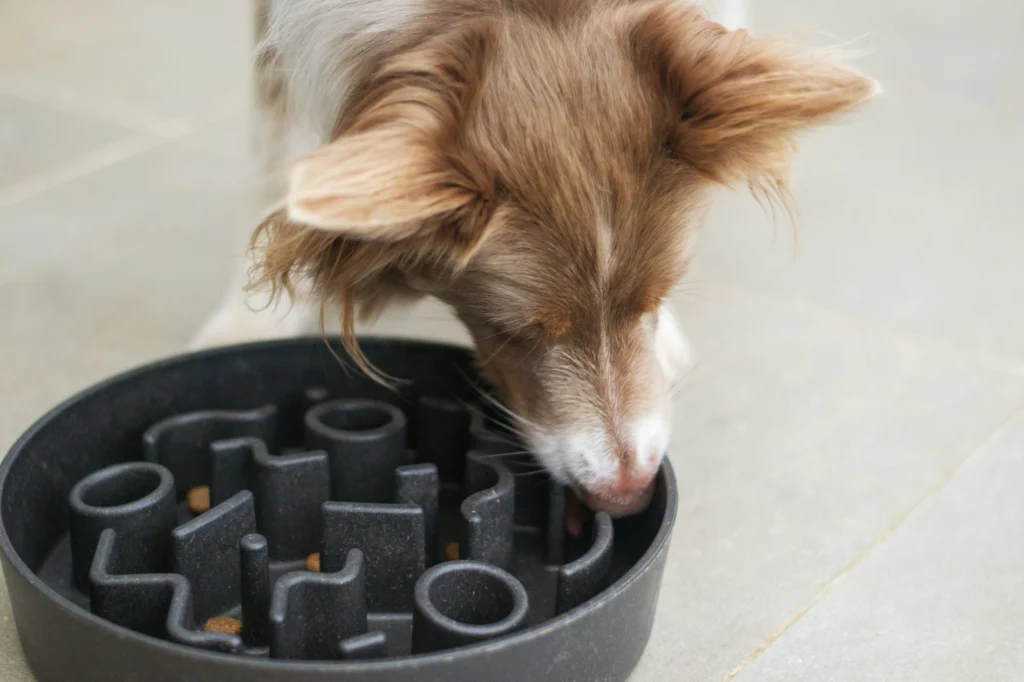
A slow feeder for beagles is a bowl with ridges, channels or a maze inside that breaks a meal into many small bites, which suits a breed known for wolfing food and gaining weight easily. The best pick for most adult Beagles is a medium sized, non slip bowl with moderate pattern depth, used alongside measured portions and scent games that feed the Beagle nose as well as the stomach.
This post looks at the Beagle side of the story: why this scent hound tends to treat every meal like a race, which bowl features matter for a Beagle’s size and muzzle, how to pair a slow feeder with sniffing games, and how to stop a determined Beagle from finding food you did not plan to give. If you want the general background first, our complete guide to slow feeder bowls covers how the different designs work.
Does a Beagle Need a Slow Feeder?
Many Beagles benefit from a slow feeder because they are strongly food motivated and many of them eat as fast as they can. A slow feeder will not fix every eating habit, but it turns a meal that vanishes in moments into a short task, and it gives you a simple tool for the two Beagle issues owners mention most: speed and weight.
How to Pick the Right Slow Feeder for Your Pet
Get our expert cheat sheet delivered to your inbox — plus an exclusive 15% discount code for your first order.
The American Kennel Club explains that dogs who eat too fast gulp down extra air along with their food, which is linked with bloat, and that slow feeder bowls are one of the main ways to encourage a slower pace. The same article notes that food puzzles work in a similar way, because their nooks and crannies make large gulps impossible.
Signs your Beagle is a good candidate include:
- The bowl is empty within a few moments of being put down.
- Your Beagle coughs, gags or regurgitates soon after eating.
- Your Beagle pushes the bowl around the floor or licks it long after it is clean.
- Your Beagle is carrying extra weight, or your vet has mentioned it.
If you are not sure whether your dog really eats too fast, our post on signs your dog eats too fast walks through each sign. If your Beagle vomits often, chokes, or shows a swollen or tight belly with restlessness, do not wait for a new bowl to help. Call your vet straight away.
The Beagle Appetite: Why a Scent Hound Treats Dinner Like a Hunt
Beagles were bred to follow a scent for hours, and that drive to find and finish food shows up at mealtimes. PDSA describes Beagles as originally bred as scent hounds and notes their strong hunting instincts. The Association for Pet Obesity Prevention puts it more bluntly on its Beagle weight page: Beagles are famously food motivated.
Food motivation is not only about breed. Writing for the Tufts Petfoodology blog, veterinary nutritionist Lisa Freeman explains that food motivation is influenced by genetics, but also by training, early life experiences, diet, and whether a dog lives in a multi dog or single dog home. So your Beagle may be a gentle grazer or a vacuum cleaner, and both are normal.
For the vacuum cleaner type, three habits are common:
- Racing the clock. The dog eats as if another dog might take the food, even in a one dog home.
- Constant searching. After the meal, the nose keeps working: floors, laps, bags and bins all get checked.
- Begging that pays. If begging has ever earned a scrap, many Beagles keep trying with great patience.
A slow feeder addresses the first habit directly. The other two need routine and management, which we cover further down.
Weight Gain, Meal Speed and What a Bowl Can and Cannot Do
A slow feeder can make a Beagle’s meal last longer, but it does not reduce calories on its own, so weight control still depends on measuring food and counting treats. This matters because Beagles appear on the list of breeds with a tendency to gain weight.
The AKC article on dog obesity notes that one study found a predisposition to obesity in some breeds, and Beagles are included alongside Basset Hounds, Dachshunds and Labrador Retrievers. The same article lists health problems made worse by obesity, including osteoarthritis, diabetes and heart disease, and says extra weight has been shown to shorten a dog’s life.
A few numbers help you keep perspective. APOP lists typical starting ranges for adult Beagles of about 20 to 22 lb for females and 22 to 24 lb for males, at a height of 13 to 15 inches. It adds that many adult Beagles fall outside these ranges depending on size variety, so body condition matters more than the number on the scale. PDSA gives an average weight of 9 to 11 kg and a height of 33 to 40 cm.
APOP’s practical feeding tips are simple and worth following with any bowl:
- Measure meals with a measuring cup or kitchen scale.
- Keep treats under 10% of daily calories.
- Recheck weight and body condition every 2 to 4 weeks.
Calorie content also varies a lot between foods. Tufts notes that dry over the counter dog foods range from about 300 calories per cup to over 700 calories per cup, so a “cup” means very different things from one bag to the next. Our portion control guide and the how much to feed a dog guide explain how to work out a daily amount. If your Beagle already needs to lose weight, see our post on using a slow feeder for dog weight loss and plan the target with your vet.
Choosing a Slow Feeder for Beagles: Size, Depth and Grip
The right slow feeder for a Beagle is a medium sized bowl that holds a full measured meal, has a pattern the dog can reach into without jamming its muzzle, and stays put on the floor. Beagles are a medium breed with a moderate length muzzle and long ears, so a few details are worth checking before you buy.
Capacity that matches the meal
Measure your Beagle’s usual meal in a cup, then check that the bowl’s stated capacity is larger. A bowl that overflows tempts you to pour the extra into a second dish, which defeats the purpose. Our post on what size slow feeder your dog needs has a step by step sizing method.
Pattern depth for a medium muzzle
Very deep, narrow channels can frustrate a dog that cannot reach the last pieces, while very shallow ridges barely slow a keen eater. For most Beagles, moderate depth with rounded channels is a good middle ground. Start easier and make it harder later, rather than the other way round.
Grip and weight
Determined eaters push bowls. A non slip base or suction cups keep the bowl in one place, which also cuts down on kibble scattered across the kitchen.
Ears and cleaning
Long ears can trail into wet food. A wide, low bowl keeps ears clearer than a deep narrow one, and a material that washes easily makes daily cleaning less of a chore. Our guide on cleaning slow feeders and lick mats covers the routine.
| Feature | What to look for | Why it matters for a Beagle |
|---|---|---|
| Capacity | Larger than one measured meal | The whole meal goes in one slow bowl |
| Pattern depth | Moderate, rounded channels | Slows a keen eater without frustration |
| Base | Non slip pads or suction cups | Stops a pushy eater moving the bowl |
| Shape | Wide and low | Keeps long ears out of the food |
| Material | Easy to wash, sturdy | Daily cleaning and some chew resistance |
Pets Sparkle Bowls That Suit a Beagle
Pets Sparkle bowls are designed for small to medium dogs and cats, which makes them a sensible size range for most adult Beagles. Here is how three of them line up with the checklist above, using the sizes listed on each product page.
- Triple Maze Feeder. This bowl has three maze depths in one design, so you can start on the easier section and move to harder ones as your Beagle learns. It measures 10.35 x 10.35 x 3.07 inches, holds up to 1.5 cups of food, has a non slip base, and is listed as ideal for small to medium dogs and cats.
- Labyrinth Slow Feeder Bowl. A silicone bowl with winding channels and suction cups, sized at 19 x 22 x 3 cm. The low profile suits wet food and kibble and keeps long ears out of the way.
- Fish and Honeycomb Slow Feeder Bowl. A softer pattern of shallow cells with a suction base, about 19 x 19 x 4 cm. It is a gentle starting point for a Beagle that has never used a slow feeder.
You can compare these and other designs in our slow feeder bowls collection. If your Beagle is at the heavier end of the breed range or eats large meals, check the capacity carefully against your measured portion before choosing.
Use the Beagle Nose: Snuffle Mats and Scatter Feeding
For a scent hound, sniffing out food is one of the most natural ways to slow a meal down, and it often settles a Beagle better than a bowl alone. Instead of only making food harder to reach, you make it something to find.
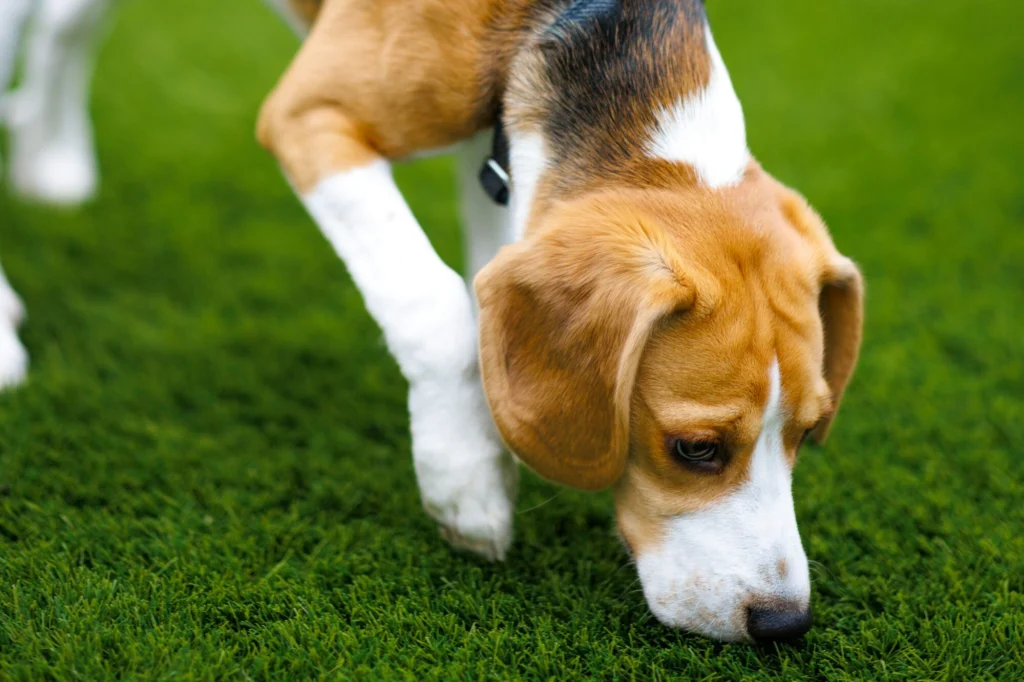
Easy ways to bring the nose into mealtimes:
- Snuffle mat. Sprinkle part of the measured meal into a fleece mat and let your Beagle sniff out each piece. The Foraging Snuffle Mat has fleece strips and pockets for hiding kibble or treats. Our post on snuffle mats for dogs explains how to set one up.
- Scatter feeding. Toss a handful of kibble across a clean patch of lawn or a mat indoors and let your dog search. Use only part of the meal so you can still see how much was eaten.
- Find it games. Hide a few pieces under cups or behind furniture and send your Beagle to search. Start easy so the dog wins quickly.
Keep scent games within the daily food allowance. The nose work is the reward, so the meal does not need to get bigger.
Keeping a Bored Beagle Busy With Food Puzzles
A Beagle with nothing to do often finds its own job, and food puzzles give that energy a better outlet. PDSA notes that, like any dog, Beagles can be destructive when bored and recommends keeping their minds active with training and plenty of exercise, with a minimum of 1 hour of exercise a day. It also warns that Beagles can be more vocal than other dogs when left alone, and suggests making sure there is plenty to keep them occupied.
A food puzzle will not replace walks, but it adds a mental workout to food your dog was going to eat anyway:
- Treat dispensers. The Duck Treat Dispenser releases kibble a little at a time when the tail is pressed and comes with three challenge lids, so you can raise the difficulty as your Beagle learns.
- Maze bowls with harder sections. Move from the easiest section of a multi level bowl to a deeper one over a few weeks.
- Rotation. Offer a different puzzle on different days so the challenge feels fresh.
If your Beagle gets frustrated, chews the puzzle or gives up, make it easier and progress in smaller steps. Our post on puzzle feeders for dogs and boredom has more ideas, and the interactive dog puzzle toy guide compares the main types.
Beagle Proofing the Kitchen and Feeding Area
A slow feeder only helps if the measured meal is the only food your Beagle gets, so the space around mealtime matters as much as the bowl. A food driven nose will find dropped crumbs, unattended plates and open bins, and those extras add up.
- Feed in one quiet spot. A calm corner away from other pets lowers the urge to race. If you have more than one dog, feed them apart and pick bowls up when they are done. Our post on feeding multiple dogs covers this in detail.
- Store food out of reach. Keep the food bag in a closed cupboard or a lidded container a Beagle cannot open.
- Secure the bin. A bin with a firm lid, or one inside a cupboard, removes one of the most tempting targets.
- Clear counters and plates. Do not leave food at nose height, and ask guests not to share scraps.
- Use training time. Some kibble from the daily allowance can be used as training rewards, so you are not adding a second stream of treats.
Watch the slow feeder itself, too. Supervise a new bowl for the first few meals and check silicone or plastic for bite marks. Replace any bowl that is cracked or chewed so pieces do not break off.
How to Introduce a Slow Feeder to Your Beagle
Most Beagles accept a slow feeder quickly if the first few meals feel easy and rewarding. The goal is for your dog to think of the new bowl as a fun place to find food, not a barrier.
- Start with a few tasty pieces. Drop some kibble on top of the pattern so the first bites are simple.
- Serve part of the meal. For the first day or two, put half the meal in the slow feeder and the rest in the old bowl afterwards.
- Use the easy setting. If the bowl has more than one difficulty level, begin with the shallowest.
- Stay nearby. Watch how your Beagle works the bowl. Calm licking and nosing is good. Barking at the bowl or walking away means it is too hard.
- Move to full meals. Once your dog finishes calmly, serve the whole measured meal in the slow feeder.
Our post on how to introduce a slow feeder goes into more detail, including what to do if your dog refuses the bowl at first. For a Beagle puppy, choose a shallow design and follow the advice in our slow feeders for puppies post, because young dogs are still learning and tire of hard puzzles quickly.
Feed the Nose, Not Just the Stomach
A slow feeder for beagles works best as part of a simple routine: a measured meal, a bowl sized for a medium dog, a little scent work, and a kitchen that does not hand out extra snacks. Beagles are famously food motivated, so you will not change their love of dinner, but you can make each meal last longer, give that clever nose a job, and keep weight in check. Start with an easy pattern, watch your dog, and step up the challenge only when mealtimes stay calm.
Get Your Free Slow Feeding Cheat Sheet
Everything in this article — plus portion charts, feeder comparisons and meal plans — in one printable PDF. A 15% discount code is included.
Frequently Asked Questions
Do Beagles need slow feeders?
Not every Beagle needs one, but many benefit because the breed is famously food motivated and many eat very fast. A slow feeder breaks the meal into small bites and makes it last longer. If your Beagle finishes in moments, gags, or is gaining weight, a slow feeder is worth trying alongside measured portions.
What size slow feeder is best for a Beagle?
Choose a medium bowl that holds more than one measured meal, with moderate pattern depth and a non slip base. Beagles are a medium breed, with PDSA giving an average weight of 9 to 11 kg. A wide, low bowl also keeps long ears out of wet food.
Will a slow feeder help my Beagle lose weight?
A slow feeder makes meals last longer, but it does not cut calories by itself. Weight loss depends on measuring food, limiting treats and regular weight checks. APOP suggests keeping treats under 10% of daily calories. Ask your vet to set a target weight and a safe plan.
Can I use a snuffle mat instead of a slow feeder for my Beagle?
Yes, for part of the meal. Snuffle mats suit a scent hound well because your Beagle sniffs out each piece. Many owners use a slow feeder for the main meal and a snuffle mat or scatter feeding for a portion, all taken from the same measured daily amount.
Why is my Beagle always hungry?
Food motivation is partly genetic and partly learned, so many Beagles act hungry even when fed enough. Keep meals measured, avoid rewarding begging, and use scent games for enrichment. If your Beagle suddenly eats much more than usual, loses weight, or seems unwell, see your vet to rule out a medical cause.
Sources

Digital marketing specialist at BrightSeen Marketing Agency. Turns veterinary research into clear, practical feeding guides for pet parents.
Mahmoud works for BrightSeen Marketing Agency, which looks after our SEO and GEO and Meta ads.
View all articles by Mahmoud